Home / Research
Research
Discoveries can change a child's life
The Children’s Tumour Foundation supports research that helps drive treatments and aims to provide valuable insights that help to improve outcomes for every person who is impacted by NF.
We collaborate with researchers to ensure that people who are impacted by NF are aware of the research projects and can participate in studies that are happening within Australia and internationally.
Model of care guidelines
A project is underway, working with a multidisciplinary panel of clinicians and people with lived experience, to develop national standard models of care guidelines for NF.
The work is being led by the Children's Tumour Foundation, and supported by our partner Alexion Pharmaceuticals.
The research will involve a systematic literature review and a Delphi consultation process, resulting in evidence-based guidelines. The development of National Standards of Care will help form a coordinated advocacy strategy, ensuring consistent, high-quality care for people with NF across Australia.

Health + social impact study
A first of its kind study in Australia, the 2024 report provides a comprehensive understanding of the physical, psychosocial and financial impact of all types of NF on individuals, families and the broader community. See key findings and recommendations.

NF Clinical Symposium
The Children's Tumour Foundation hosts this event showcasing both Australian and international speakers, designed to stimulate new collaborations, demonstrate progress and fuel new ideas to conquer NF. Read the summaries and speaker interviews from the 2025 NF Symposium.
Recruiting studies
The SOAR Study - Aiming to understand life for adults Neurofibromatosis type 1.
The SOAR (Studying Outcomes in Adult RASopathies) Study, conducted by the Murdoch Children's Research Institute, aims to help researchers and clinicians who care for people with these genetic conditions understand what it’s like to live with them in adulthood.
The Northern Sydney Local Health District NF1 Pregnancy Study
Are you trying to get pregnant or in the early stages of pregnancy (less than 13 weeks)? The Clinical Genetics Research team are conducting a new pregnancy study to understand how pregnancy may affect skin neurofibromas and plexiform neurofibromas in women with NF1.
NF1 Cutaneous Neurofibroma Consortium Project
This research aims to work in partnership with adults living with NF1 to improve our understanding of how genetics affects the number of skin neurofibromas a person with NF1 may develop and how to treat skin neurofibromas in the future.
NF research we have helped fund
Tint: Mek Inhibitor trial
New Gene Editing Technology (CRISPR)
Neurofibromatosis Type 1 Severity Scale
Children with NF1 & Auditory Processing Deficits + Speech Perception Problems
Predicators of Autism in NF1: Development in Adolescence (PANDA)
Documenting and characterising the various MRI brain changes
Cell-free Bio bank
The power of research
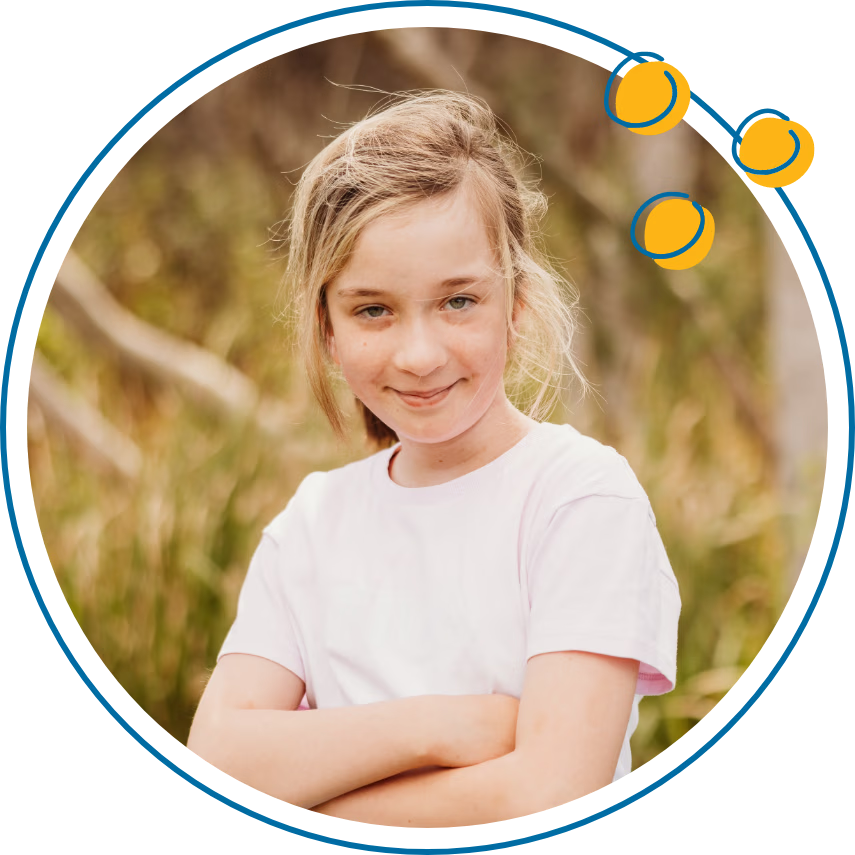
Alex was diagnosed with neurofibromatosis type 1 (NF1) shortly after birth, showing early signs through café-au-lait spots and developmental delays. At 18 months, a plexiform neurofibroma (PN) began to develop on her jaw.
To manage the tumour, Alex underwent regular MRIs and participated in speech therapy, occupational therapy, and physiotherapy to support her development.
Due to the tumour’s size and location, Alex was selected to take part in a two-year clinical trial for Trametinib, a MEK inhibitor showing promising results in stabilising and shrinking plexiform neurofibromas. The treatment had a remarkable effect, reducing the size of her tumour by 50% over two years.
She continues to be monitored through the Royal Children’s Hospital NF Clinic in Melbourne, where a multidisciplinary team helps manage her condition.
Today, Alex is thriving at school, loves soccer, swimming, and dancing, and faces each challenge with incredible strength and positivity.