Supporting Auditory Processing Difficulties in Children with NF1 Using an Assistive Listening Device - Health Care Professionals
November 27, 2025
NF Clinical Symposium Research Summarised
For Health Care Professionals
The information provided below is a summary of the presentation titled 'Supporting Auditory Processing Difficulties in Children with NF1 Using an Assistive Listening Device' given by Dr Hayley Darke on 4th August 2025 at the NF Clinical Symposium in Sydney.

At this year’s NF Clinical Symposium organised by the Children’s Tumour Foundation (CTF), Dr Hayley Darke, Clinical Neuropsychologist from the Murdoch Children’s Research Institute (MCRI) in Melbourne, presented on supporting auditory processing difficulties in children with Neurofibromatosis type 1 (NF1) through the use of a remote-microphone assistive listening device.
Learning and attention difficulties are highly prevalent among children with NF1 and are a major concern for parents, educators, and treating clinicians. Previous research from the Brain and Mind research team led by Associate Prof Jonathan Payne at MCRI identified auditory processing difficulties in approximately 45% of children with NF1, despite normal peripheral hearing. These children experience significant challenges in perceiving speech against background noise — such as following a teacher’s instructions in a busy classroom — which can interfere with communication, participation, and academic progress. Addressing these deficits represents an important therapeutic need.
Auditory Processing Disorders in NF1 is not attributable to peripheral hearing loss and therefore is not detected on standard audiometric testing. Instead, these children struggle with the discrimination of sounds, which requires specialised auditory processing tests to be detected. In educational settings, these children may have difficulty separating the teacher’s voice from ambient noise, resulting in reduced attention and missed instructions. This disadvantage means that they are more likely to disengage and ‘tap out’ during learning activities, potentially leading to poorer academic outcomes.
The research team conducted a preliminary pilot study involving ten participants hypothesising that a remote-microphone listening device may be a viable tool to mitigate the effects of background noise. They tested the efficacy of a remote-microphone listening device designed to enhance signal-to-noise ratio in classroom environments. The system consists of a small earpiece worn by the child that connects wirelessly to a microphone worn by the teacher, amplifying the teacher’s voice above background noise.
Following promising pilot results the study has now been expanded to a larger trial, the Tap-iN trial (Treating Auditory Problems in Neurofibromatosis) and is currently running at the Royal Children’s Hospital in Melbourne and the Children’s Hospital at Westmead in Sydney. The TAP-iN trial is recruiting children with NF1 aged between 6 and 12 years who may or may not have difficulties with speech-in-noise. The first phase of the trial compares the listening skills and experiences of primary school-aged children with and without using the device over a 4-week period.
The second phase of the trial follows the progress of children with NF1 using the remote listening device in school for approximately 30 weeks. This second phase of the Tap-iN trial investigates the broader impact of the device on academic skills, attention and concentration, behaviour, emotional wellbeing, and overall quality of life. The research team also hopes to learn more about the physiological functioning of the auditory system in NF1 using an evoked potential called the auditory brainstem response. This component of the study may elucidate the neurobiological underpinnings of auditory processing deficits in this population.
In the near future Dr Darke and her colleagues hope to present a potential solution to lessen the real-world impacts of Auditory Processing difficulties and provide an accessible, classroom-based intervention that may mitigate educational and psychosocial impacts. Preliminary findings suggest that remote-microphone technology has the potential to facilitate engagement and learning by enabling children with NF1 to effectively “tap in” to their classroom environment.
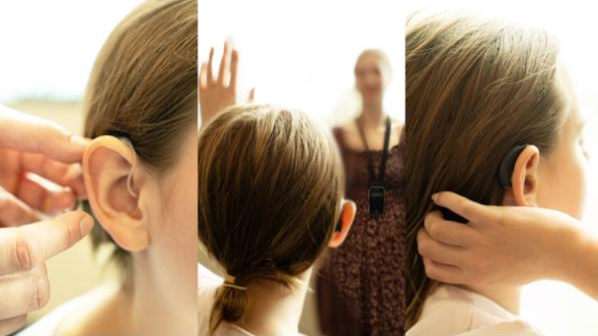
Illustration of a child wearing the remote listening device in proximity of the teacher.
Image credit: Renee Pascouau - Genetics and Neurodevelopment, MCRI.
Share this article