Remote listening device offers a boost to speech perception in NF1 - Patients and Carers
October 14, 2025
NF Clinical Symposium Research Summarised
For Patients and Carers
The information provided below is a summary of the presentation titled 'Supporting Auditory Processing Difficulties in Children with NF1 Using an Assistive Listening Device' given by Dr Hayley Darke on 4th August 2025 at the NF Clinical Symposium in Sydney.
Dr Darke is a clinical neuropsychologist from the Murdoch Children’s Research Institute (MCRI) in Melbourne. Her research focuses on helping children with neurofibromatosis type 1 (NF1) who have trouble hearing and understanding speech in noisy places.
My child doesn’t have a hearing problem so why can’t they understand the teacher?
Many children with NF1 find learning and concentrating at school difficult. One reason for this is that around 45% of children with NF1 have an auditory processing disorder which means that they have trouble deciphering sounds, even though their hearing tests are normal..
What is an auditory processing difficulty?
Auditory processing difficulties don’t mean the child has a hearing problem. Instead, their brain finds it hard to sort out speech from other sounds. Specialised auditory processing tests need to be done to pick up these issues. Often these speech-in-noise difficulties can impact everyday life. At school for example, children with these difficulties may find it hard to distinguish the teacher’s voice from background noise in the classroom, causing them to miss crucial information. This means that they are more likely to disengage and ‘tap out’ during learning activities, potentially leading to frustration and poorer academic performance.
What is the new research?
Australian research is exploring a potential solution. Dr Darke and her team are studying whether a special listening device can help. This device consists of a small earpiece worn by the student that connects to a microphone lanyard worn by the teacher. As a result, the teacher’s voice is amplified to a level that is more easily detectable (louder and clearer) over competing background noise.
A small pilot study with 10 children showed good results, so now the team is running a larger study called the Tap-iN Trial (Treating Auditory Problems in Neurofibromatosis). This study is happening at the Royal Children’s Hospital in Melbourne and The Children’s Hospital at Westmead in Sydney.
What happens in the study?
The Tap-iN Trial is for children aged 6–12 years with NF1.
· The first phase of the trial compares the listening skills and experiences of primary school-aged children with and without using the device over a 4-week period.
· The second phase of the trial follows the progress of children with NF1 using the remote listening device in school for approximately 30 weeks.
The researchers are looking at how the device affects learning, attention, behaviour and quality of life. They are also studying how the brain processes sound using a safe test called an auditory brainstem response (ABR).
Why this matters
This research is geared towards a better understanding of speech-in-noise hearing difficulties in NF1. They hope to present a potential solution to help children with NF1 who struggle to hear in noisy places, like classrooms. Using this simple device might make it easier for children to listen, stay engaged, and do better and ‘tap in’ to classroom learning.
If you would like more information or would like your child to participate in the research trial, please contact the CTF Support Services Team support@ctf.org.au
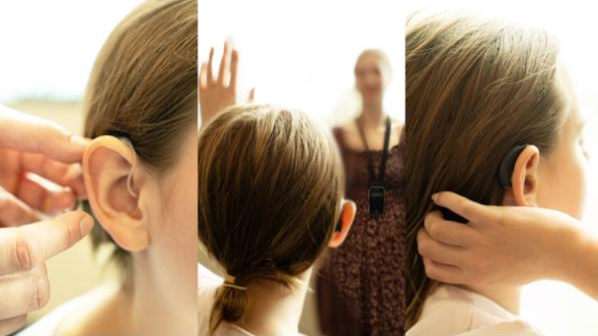
'Illustration of a child wearing the remote listening device in proximity of the teacher.
Image credit: Renee Pascouau - Genetics and Neurodevelopment, MCRI.'
Share this article