NF2-SWN: The burden of repetitive tumour imaging addressed
September 27, 2026
A research summary for patients and carers
The information provided below is a summary of a recent research study on NF-2 Related Schwannomatosis (NF2-SWN) at the 2026 NF Conference in the US. This inspiring presentation features the latest research project by Dr Frank Buono from Yale University.
Click here to read the summary for Health Care Professionals
As the science communicator of this series on updates from the 2026 NF Conference, I would like to draw attention to a special conference session on NF2-SWN, which focussed on a range of research projects with potential clinical impact and promising opportunities for the translation of new research findings into practice.
The talk by Dr Buono on an improved approach to MRI tumour assessments in NF2-SWN was part of this session. It attracted special attention from the conference organisers at CTF in the US, who included its significance in their 2026 NF Conference Recap as follows:
“A new AI tool shows potential in measuring NF2-related tumor growth on an MRI in about a minute, compared to up to an hour by hand, and it has the potential to detect subtle growth that traditional methods may miss.”
AI-assisted MRI enhances quality of imaging in NF2-SWN
Who is Dr Frank Buono?
Dr Frank Buono is a clinical psychologist who leads a team of researchers at the School of Medicine at Yale University in the US. He is also a patient with NF2-SWN, which allows him to include the patient perspective in his research projects aimed at making life with vestibular schwannomas better. For example, he understands the burden on NF2-SWN patients of having to undergo magnetic resonance imaging (MRI) as part of their routine check-ups on a regular basis.
Why is MRI an important part of regular NF2-SWN medical checks?
MRI is considered the gold standard for the checks on tumour growth in NF2-SWN at every routine visit of the patient. The frequency of health reviews can vary per patient from every few months to every 2 years depending on the severity of the disease.
To estimate tumour size at each follow-up, the standard approach is MRI with 2D volumetric analysis, which is based on length and width measures of the tumour as determined by the neuro-radiologist, who interprets the images.
How can tumour size examination be made better?
Vestibular schwannomas are often irregular in shape and their position within surrounding biological structures can be helpful to know. Using 3D volumetric analysis to measure the size of the tumours can provide more detailed information.
3D volumetrics is based on integrating the MRI information from all imaged slices across all areas of the tumour. This results in a comprehensive 3D representation of the actual tumour shape, size and precise location.
Why is AI required for 3D Volumetrics?
According to Dr Buono, MRI with 3D volumetrics is an improvement over standard MRI with 2D volumetric analysis, but in reality it is still not be the solution either. Yes, MRI with 3D volumetrics is more objective and consistent, but it is also a demanding technical tool and its use in practice is hampered by the hours it takes to scan a patient.
Dr Buono argued that this is where artificial intelligence (AI) can help. He and his team developed an AI-assisted version of 3D Volumetric software (Defin3D). Most importantly, the software reduces the length of MRI assessment time from hours to minutes
It also sets up MRI for longitudinal evaluation to shed light on the rate of tumour growth over time. Tumour growth can vary from no growth to a fast rate at different times and comparison of new imaging outcomes with those from previous appointments is another step forward.
The patient perspective on AI use in health checks
Dr Buono is excited about the many benefits of AI-assisted 3D volumetrics for patients with NF2-SWN, but he is also acutely aware of the reservation patients may have regarding the AI-component of the new screening approach.
As part of the research to create Defin3D, he also interviewed 60 patients with NF2-SWN to understand their cautiousness with or fear of AI. The survey showed that patients understand that AI can be a supportive tool in healthcare. However, there also seemed reluctance to trust the analysis of tumour progression if operating without human involvement.
What’s next?
Dr Buono and his team continue to optimise Defin3D for future use in the clinic. Key to this process are training, testing and validating the model to meet the expectations of clinical NF experts.
His diligent research approach also aims to considers the important aspect of patient trust in a system helped by AI, but overseen by the specialist clinician.
Dr Buono was Invited to speak at the conference as someone knowledgeable on the topic with the lived experience of having to be monitored regularly for tumour progression. This brought an extra dimension to the introduction of Defin3D, which has the potential to upgrade tumour growth assessments in NF2-SWN with the patient in mind.
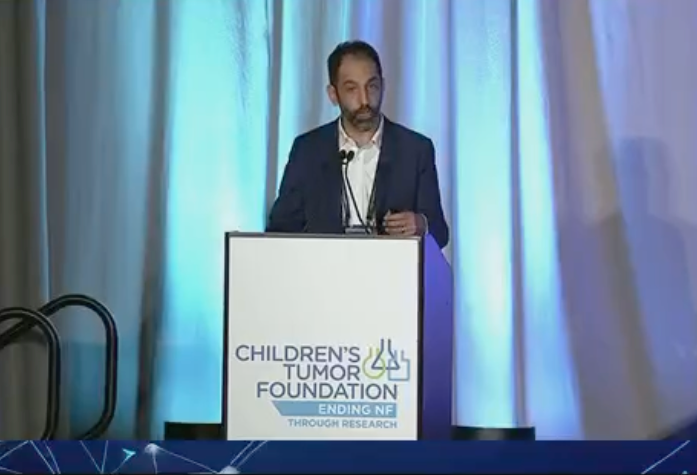
Speaker at the 2026 NF Conference: Dr Frank Buono
This article was written by
Anke van Eekelen
Research volunteer

Share this article