Challenges faced by patients with NF when planning to have children - Patients and Carers
November 27, 2025
NF Clinical Symposium Research Summarised
For Patients and Carers
The information below is a summary of the presentation titled ‘NFSURE Study: Supporting Reproductive Choices and Decision-making for Adults with Neurofibromatosis’ given by Dr Brooke Gardiner on 4th August 2025 at the NF Clinical Symposium in Sydney.

Dr Gardiner is a Clinical Genetics and Genetics Research Fellow at the Royal North Shore Hospital in Sydney. She is a member of the NFSURE and NFSURE+ research team, which explores the reproductive experiences and needs of adults with NF wishing to start a family.
Why was the NFSURE study undertaken?
Adults with NF who are thinking of having children are concerned about a range issues, like the 50% risk of genetic inheritance of NF, the impact of a pregnancy on the their own health and access to specialised care providers who understand their needs. The NFSURE Study aimed to specifically explore what adults with NF struggled with to make well-informed, the decisions around parenthood. The team wanted to hear from a wide range of adults with NF1 or NF2-SWN between 18 and 65 years of age, including those who had decided not to have children.
What were the most important revelations of the NFSURE study?
Dr Gardiner explained how complex reproductive decision-making can be for people with NF. She also highlighted the urgent need for better patient-centred care, tools and supporting resources to help those with NF considering a pregnancy.
Which factors had significant impact on the decision-making process to have children or not?
Analysis of face-to-face conversations with 16 study participants divided over 3 focus groups showed the following influences on reproductive decision-making by people with NF to be most prominent:
· Lack of accurate information and insufficient professional support
· Financial concerns and emotional burden
· Uncertainty about the future health of offspring
· Cultural and/or familial expectations
How was the study designed?
At first, the research team invited 16 participants with NF1 or NF2-SWN to discuss their thoughts on planning a family and what barriers they felt complicated reproductive decision-making. It is important to note that these conversations were held in small group settings with semi-structured guidance by a research member to allow a deeper understanding of those issues raised and prioritised by the participants.
A larger online survey then allowed 126 more individuals with NF1 or NF2-SWN to respond to questions driven by key themes that came out of the focus groups. This 2-step approach is a validated mixed-method approach to combine all information collected to show what type and degree of burden of real life challenges are faced by adults with NF and wishing to start their own family.
What did we learn from the survey?
The survey responses supported the initial concerns raised in the focus groups. On top of that, it revealed additional fears that a pregnancy could worsen neurofibroma growth in women with NF1, and worries around the effects of medication withdrawal during a pregnancy in women with NF2.
Nearly half of the survey respondents (47.1%) wanted more professional help with reproductive decision making and better information on genetic risk and reproductive technology options. To be better prepared early reproductive education, preferably during face-to-face meetings with health professional, should start in adolescence.
Where to from here?
Reproductive health conversations are now recommended to become ‘standard of care’ when people with NF transition to adulthood with a greater focus on counselling, be it on genetic risk, fertility aspects or pregnancy-related adaptation of medication.
New tools have already been developed and are available for people with NF to be better informed and make educated choices:
-A brochure “Thinking about having Children: For People with Neurofibromatosis” -Updated website content on reproductive options in NF.
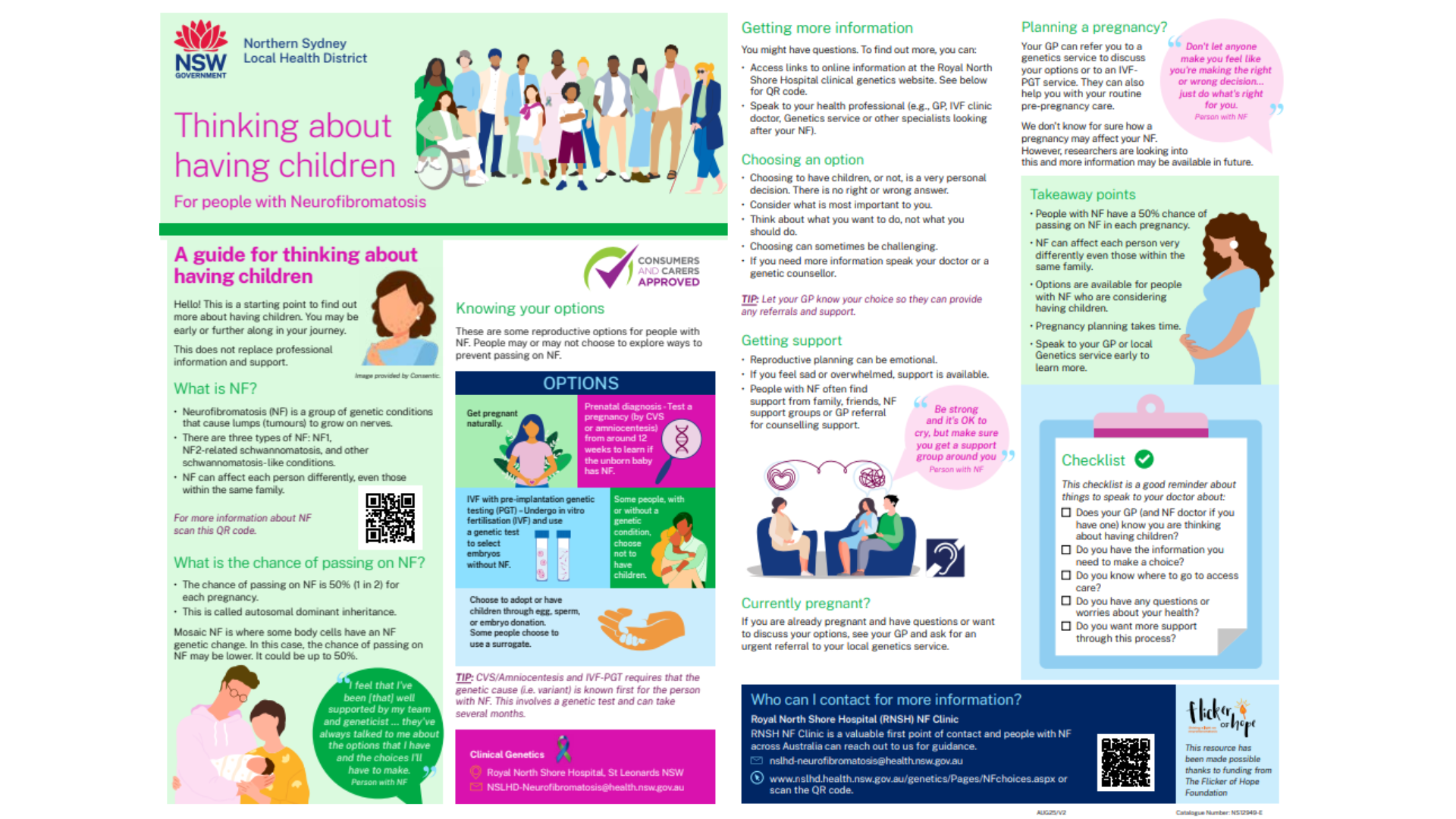
An impression of the brochure ‘Thinking about having Children: For People with Neurofibromatosis, included with permission of the NFSURE research team. This resource was developed with funding from The Flicker of Hope Foundation, includes an image provided by Consentic and can be downloaded here.
A follow-up study has now started: NFSURE+
This ongoing research addresses the specific concern that a pregnancy could worsen neurofibroma growth in women with NF1. It examines how pregnancy and hormonal changes more broadly during the life span of women with NF1 impact on neurofibroma growth.
If you have NF1 and of reproductive age, you are either pregnant or planning a pregnancy, you are invited to join this important new research project – for more information please click here or contact NSLHD-GeneticsResearch@health.nsw.gov.au
Share this article