The many faces of NF1 and what this means for neuropsychological testing
November 01, 2026
A research summary for patients and carers
The information provided below is a summary of a recent neuropsychological study in NF1 within the context of an expert panel discussion on brain development in NF1 at the 2026 NF Conference in the US.
Click here to read the summary for Health Care Professionals
Prof Jonathan Payne is a clinical neuropsychologist and Co-Lead of the Brain and Mind research group at the Murdoch Children’s Research Institute in Melbourne. He has extensive experience in working with children and adults with NF1.
His research has been published in highly respected scientific journals and his network of research collaborations on brain development, cognition and behaviour in NF1 extends beyond the borders of Australia.
Prof Payne was invited to be part of an expert panel within a special session on brain development in NF1. We thank Prof Payne for his support to use parts of the panel discussion to create context for an inspiring presentation by Dr Yang Hou from Florida State University in this series. In his view, this specific talk had a take home message with immediate clinical relevance.
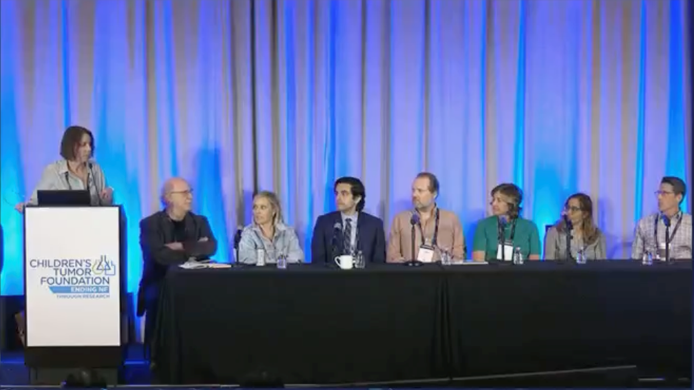
Expert panel on brain development in NF1 at the 2026 NF Conference with members from the US, UK and Australia. Dr Payne is pictured 4th from the right.
A new way of looking at neurodevelopmental phenotypes of NF1 and the challenges they bring
Why are children with NF1 so different from each other?
NF1 can affect people in many ways. Two children with NF1 can face very different challenges as they grow up, even within the same family. The specific combination of challenges an individual with NF1 faces is referred to as the person’s phenotype. This gives every child with NF1 a unique ‘face’.
Scientists are still researching why, but it seems to depend on a mix of things including the specific change in the NF1 gene, the child’s other genetic influences, and environmental factors such as their family life, schooling and support they receive along the way.
How can a clinical neuropsychologists help children with NF1?
One of the most common effects of NF1 is on how the brain develops (called neurodevelopment). Changes in the NF1 gene can influence brain development very early on affecting how brain cells (neurons) grow and how they connect with each other to form networks. A brain that is wired a little differently can make some things harder for children with NF1, such as learning at school, paying attention, managing their behaviour and emotions, or getting along with others.
Clinical neuropsychologists are specialists in understanding how the brain affects learning and behaviour. They help children whose brain development makes everyday life harder. For children with NF1, this often means difficulties with schoolwork, attention and behaviour.
What happens when children with NF1 see a clinical neuropsychologist?
A clinical neuropsychologist will work to understand how NF1 is affecting learning and behaviour of a child with NF1. They look at which areas the child finds difficult, how much these difficulties affect everyday life, and what kind of support or therapy could help. They are also interested in what the child does well, because understanding the child’s strengths can help inform which supports are likely to be most useful.
An assessment usually includes activities, such as puzzles, memory tasks and reading or maths exercises. It also includes interviews with parents and teachers as well as questionnaires that ask about how the child is managing at home and school. Together, this gives a full picture of the strengths and challenges of the child. The neuropsychologist then uses this assessment to suggest supports that help build on a child’s strengths to help them in the areas they find harder.
How can testing for neurodevelopmental impairments in NF1 be made better?
In NF1, disorders particularly associated with NF1 are autism spectrum disorder, attention deficit/hyperactivity disorder (ADHD), and learning difficulties. They frequently coincide, but children with NF1 do not always meet the criteria for a precise diagnosis of specifically autism, ADHD or learning disorder.
At the conference, Prof Payne explained that these children often show ‘signs and symptoms associated with autism and ADHD, but that these behaviours in NF1 can often be a little different from those with autism or ADHD in the general population’.
He and other experts in Australia, UK and US, have introduced a new term for the cognitive and behavioural challenges specific to NF1. They encourage the use of ‘NAND’ as a new term, which stands for NF1-Associated Neurodevelopmental Difficulties.
NAND describes the mix of learning, attention, social and behaviour difficulties that many children with NF1 experience. These difficulties are real and can affect everyday life, but they often don’t fit neatly into an existing diagnosis such as autism or ADHD. Using a term specific to NF1 recognises that the challenges of these children form their own pattern, which may need its own approach to assessment and support.
The new term NAND may not necessarily make the assessment of neurodevelopmental difficulties easier since the diversity of challenges among children with NF1 will remain complex. But, if a new test designed specifically to measure NAND is available in the future, it could help recognise some of subtle differences between the many challenges dealt with in NF1, and lead to more effective treatment or support where needed.
How does the conference presentation by Dr Yang Hou relate to this new way of looking at neurodevelopmental phenotypes of NF1?
Dr Yang Hou from the College of Medicine at Florida State University is an academic expert in health psychology and neurobehaviour research. She presented a recent study in which she tried to group certain types of neurodevelopmental impairments often seen in children with NF1.
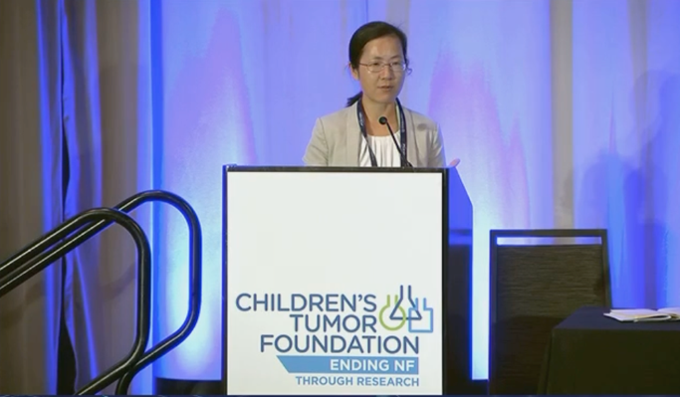
Speaker at the 2026 NF Conference: Dr Yang Hou
Dr Hou combined data from more than 1000 children with NF1, including those from previous Australian research studies. All study participants had been assessed by clinical neuropsychologists for cognitive and behavioural difficulties. The data set was so large, it enabled her for the first time to identify patterns of challenges related to NF1.
This knowledge gives insight into the scale and degree of typical neurobehavioural difficulties prevalent in children with NF1. Prof Payne believes it can help to shape the concept of NAND.
What NF1-related profiles of impairments where identified by Dr Yang Hou?
Average functioning
About 1 in 3 children with NF1 (35%) fell within the typical range for learning and behaviour. We know that not all children with NF1 have neurodevelopmental impairments, which was confirmed in this study.
Predominantly cognitive difficulties.
About 1 in 3 children (32%) had IQ scores in the lower ranges and found schoolwork harder, but had few behavioural problems.
Predominantly behavioural difficulties
About 1 in 4 children (24%), showed average learning ability but more behaviour-related challenges, including ADHD symptoms and executive functioning difficulties such as those related to planning, organisation and staying focused on the task at hand. These challenges were also more likely to coincide with mental health problems.
Global difficulties
About 9% of children faced more complex challenges. They showed clinically significant cognitive and academic impairments, elevated ADHD and executive dysfunction, as well as emotional and behavioural difficulties.
What’s next?
Dr Hou’s research findings show that children with NF1 whose challenges are mainly with learning can be distinguished from those whose challenges are mainly with behaviour. This matters because the right support depends on the type of difficulty a child has.
Children with learning difficulties may benefit most from extra help at school. Children with behaviour challenges may benefit most from support for behaviour, emotions and social skills. For children with ADHD symptoms, this may also include ADHD medication, such as stimulants, prescribed and monitored by their doctor.
In the future, better neuropsychological assessment for NF1 may help clinicians recognise each child’s particular profile of challenges more clearly. This could lead to more targeted support and therapeutic intervention. More research in this area will be an important next step towards improving daily living for children with NF1.
This article was written by
Anke van Eekelen
Research volunteer

Share this article