The many neurodevelopmental phenotypes in NF1: How to best research, assess and treat?
November 01, 2026
A research summary for Health Care Professionals
The information provided below is a summary of a recent neuropsychological study in NF1 within the context of an expert panel discussion on brain development in NF1 at the 2026 NF Conference in the US.
Click here to read the summary for Patients and Carers
Prof Jonathan Payne is a clinical neuropsychologist and Co-Lead of the Brain and Mind research group at the Murdoch Children’s Research Institute in Melbourne. He has extensive experience in the field, gained over 18 years of working with children and adults with NF1.
His research has been published in highly respected scientific journals and his network of research collaborations on brain development, cognition and behaviour in NF1 extends beyond the borders of Australia.
Prof Payne was invited to be part of an expert panel as part of a special session on brain development in NF1. The panel was introduced as a group of ’collective brilliant brains’ with lots of experience to discuss the challenge of translating neuropsychology research into clinical practice.
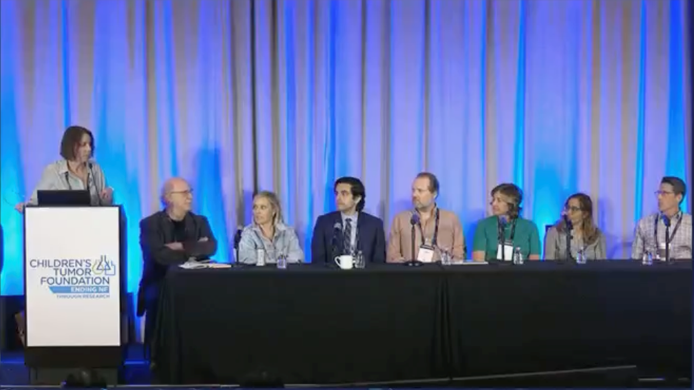
Expert panel on brain development in NF1 at the 2026 NF Conference with members from the US, UK and Australia. Dr Payne is pictured 4th from the right.
We thank Prof Payne for his support to use parts of the panel discussion to create context for an inspiring presentation by Dr Yang Hou from Florida State University in this series. In his view, this specific talk had a take home message with immediate clinical relevance.
Neuropsychological testing: The issue of phenotypic heterogeneity
NF1 affects people in many different ways and its heterogeneity includes neurodevelopmental phenotypes associated with difficulties with cognition, development, learning and behaviour.
Clinical neuropsychologists are particularly challenged by NF1 heterogeneity, as the effects of NF1 on brain development and function vary considerably from one child to the next. Neuropsychological research aims to better understand these differences so that assessment can be improved and the appropriate therapies can be developed.
The expert panel agreed that the complexity of the brain, as the central system steering the intricate development of thinking and behavioural skills, makes it difficult for researchers to study the many NF1-related processes that lead to distinctly different neurodevelopmental phenotypes observed in affected children.
Current clinical testing for cognitive, behaviour and learning deficits in NF1 uses a series of validated assessment tools, each developed for the diagnosis of specific neurodevelopmental disorders in isolation, such as autism spectrum disorder or attention deficit/ hyperactivity disorder (ADHD).
As part of the conference discussion, Prof Payne argued that the use of these established tools may not be optimal for an accurate neuropsychological diagnosis of cognitive and behavioural deficits in NF1.
Currently available assessment tools look at one area at a time, such as attention, executive function, learning, social skills or emotional wellbeing, each with their own questionnaire and ‘clinical cut-off’. Yet in NF1, these difficulties rarely occur in isolation. Many children score just below the clinical threshold in several areas at once. Judged one area at a time, they can appear to have no significant problems. Taken together, though, these “subthreshold” difficulties add up, and the overall impact on a child’s learning, friendships and everyday life can be considerable. Children with NF1 may end up with multiple diagnoses that describe what is really one underlying pattern.
As Prof Payne puts it, these children often appear “a little autistic, a little ADHD, but then again still different from those with autism or ADHD in the general population.”
This calls for a rethink of how neuropsychological assessment is carried out in NF1. In 2025, he and other NF1 specialist neuropsychologists did just that, proposing a new term for this pattern of cognitive and behavioural challenges in NF1: NAND (NF1-Associated Neurodevelopmental Difficulties).
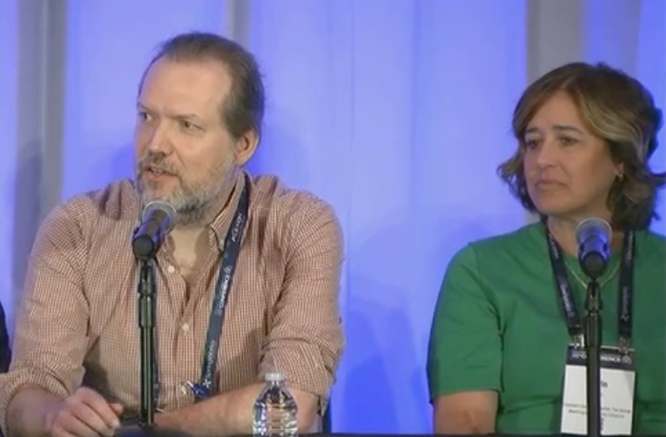
Expert Panel members at the 2026 NF Conference: Dr Jonathan Payne (left) and his US collaborator Dr Karin Walsh (right)
The team of international collaborators behind NAND included Drs Stephanie Morris and Karin Walsh from the US, Dr Shrui Garg from the UK and Dr Natalie Pride from Sydney. Prof Payne took the opportunity to introduce the concept of NAND to the conference audience in an effort to push for mainstream use of the term. It appears a welcome new initiative to more accurately describe the specific neurodevelopmental challenges faced by children with NF1.
NAND has also triggered a collaborative effort to develop a better assessment tool tailored for neuropsychological assessment in NF1. The aim is to come up with just one questionnaire for easier reporting by parents and better decision-making around interventional strategies to improve the quality of life of the NF1 patients with cognitive and behavioural difficulties.
Large research study reveals distinct neuropsychological subgroups in NF1
The conference presentation by Dr Yang Hou from the College of Medicine at Florida State University tied in closely with the discussion of NAND. She is the Director of the Development, Environment and Resilience (DEaR) Lab with specialist expertise in health psychology and neurobehavioural research.
Her recent study aimed to identify essentially different neuropsychological profiles among children with NF1. Understanding these profiles will help improve our understanding of the scale and heterogeneity of typical neurodevelopmental difficulties prevalent in children with NF1, which in turn can further shape the concept of NAND.
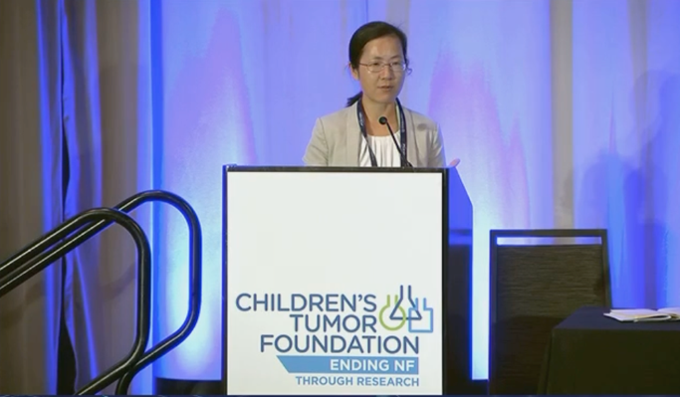
Speaker at the 2026 NF Conference: Dr Yang Hou
Dr Hou presented the outcomes of a research collaboration between 9 Specialist NF Care centres in the US, UK and Australia, which allowed for a combined dataset of more than 1000 children with NF1 between the age of 3 and 18 years old.
This unusually large dataset included comprehensive information on cognitive performance (IQ and academic abilities such as math, reading and writing abilities) and parent-reported behavioural measures covering difficulties with everyday executive functioning, attention, signs of hyperactivity and impulsivity, as well as problems related to externalizing or internalizing behaviour.
The main difference with previous research was the use of a person-centred approach. Instead of examining each area of neurodevelopment in isolation, Dr Hou examined how difficulties combined within individual children across the domains of cognition, academic achievement, executive dysfunction, ADHD symptoms, internalising and externalising problems. As the panel discussed, the domain-by-domain approach can miss children whose difficulties fall below the threshold in each area but add up to a significant overall impairment.
Dr Hou revealed that 35% of the children with NF1 had average functioning. Their outcome measures fell within the normal range across the cognitive and behavioural domains analysed. This seems in line with the understanding that not all children with NF1 have neurodevelopmental impairments.
All other children with NF1 in this study fell into 1 of 3 profiles of neurobehavioural difficulties:
- A profile of ‘predominantly cognitive difficulties’ was detected in 32% of the cohort. These children showed a lower IQ and academic underachievement, but their behavioural functioning was largely within the typical range.
- A profile of ‘predominantly behavioural difficulties’ was observed in 24% of the cohort. While showing typical cognitive development, these children displayed elevated behavioural challenges across executive functioning, ADHD symptoms as well as internalising/externalising problems.
- A profile of ‘global difficulties’ was found in 9% of the cohort. These children had clinically significant cognitive impairments and ADHD symptoms in addition to broadly elevated executive dysfunction as well as emotional and behavioural problems.
It is worth noting that boys were at higher risk of having global difficulties and the profiles were not stable across the age span with older children more likely to show largely cognitive difficulties.
Dr Hou’s research findings show that separating cognitive and behavioural difficulties in this way is achievable with immediate clinical relevance. Children with predominantly behavioural difficulties may benefit most from psychosocial interventions, along with stimulant medication for those with ADHD. On the other hand, academic support appears most helpful for those with cognitive deficits.
Her research findings led Dr Hou to define workable neuropsychological subgroups in NF1. Profiles like these may be key to overcoming the barrier that phenotypic heterogeneity poses to more accurate assessment in NF1, and to match each child with the supports most likely to help them.
This article was written by
Anke van Eekelen
Research volunteer

Share this article