Hormonal imbalance in NF1 and the complexity of pain in focus
October 31, 2026
A research summary for patients and carers
The information provided below is a combined summary of two presentations at the 2026 NF Conference in the United States, selected by Dr Alexa Burgess for communication to the NF Community in Australia
Click here to read the summary for Health Care Professionals
Dr Alexa Burgess has a child with NF1, she is a NF patient advocate and a member of the NF Community Advisory Panel at CTF Australia. She is also a scientist with a strong background and interest in research.
Alexa had the opportunity to listen to several 2026 NF Conference presentations online which met her interest to stay informed as a NF-patient advocate and parent and we thank her for the recommendation to cover two inspiring presentations with a focus on endocrine issues during child development in NF1 and better pain care for all patients with NF in this series.
Endocrinology has a role to play in NF1 care and treatment
Who is an expert in endocrinology and what do they focus on?
A medical doctor specialised in conditions caused by problems with hormones and hormone-producing glands is called an endocrinologist. This particular type of clinician is focussed on how well hormones as biological messengers in the body regulate growth and development among other functions. Some circulating hormone levels are controlled by the brain via a cascade reaction to stimulate specific glands. Any disruption to their activation along these axes from the brain to the glands (referred to as neuroendocrine axes) can cause hormonal imbalances leading to disorders called endocrinopathies.
Dr Clement Cheung is a paediatric endocrinologist at The Children’s Hospital in Los Angeles. He is familiar with growth and developmental concerns related to hormone dysfunction and was invited to speak at the conference about endocrinopathies most common in children with NF1.
How do hormonal imbalances affect children with NF1?
The most relevant issues caused by hormonal imbalances in NF1 are pubertal abnormalities and impaired growth. According to Dr Cheung, these endocrine problems are more common that we think: 19-23% of children with NF1 show at least one type of endocrine dysfunction. The risk is further increased up to 32% if the child with NF1 has developed an optic pathway glioma (OPG).
When and how much sex and growth hormones circulate during child development can point to puberty or growth issues. Dr Cheung used his presentation to wake up NF1 specialists to keep an eye out for any signs of unusual sex or growth hormone influences in their patients. They allow the identification of any problems early on to guide future management and allows patients and carers to prepare for potential pubertal abnormalities and impaired growth in NF1.
What happens during puberty?
Puberty is a normal part of growing up. It is responsible for changes in the body of a child to prepare for adulthood and sexual reproduction. Important steps in the process are regulated in the brain by activation of the hypothalamic-pituitary-gonad (HPG) axis. This is a specific neuroendocrine cascade reaction of biological events to regulate the release of sex hormones and trigger the development of secondary sex characteristics.
As explained by Dr Cheung, girls normally start puberty around 10 years of age. It involves several events:
- Thelarche, which is the developments of breasts. This typically starts around 10 years of age and it can take several years for the breasts to fully develop.
- Pubarche, which is the growth of pubic and underarm hair. This typically starts about 6 months later.
- Menarche, which is the start of menstrual periods about 2 years later. The first menstrual bleeding typically occurs around 12-13 years of age.
- A growth spurt should also occur during puberty around the start thelarche at 10 years of age and can continue throughout puberty until about 14 years of age.
Boys show the first physical signs of puberty around 11 years of age, a year later than girls. It involves different events:
- The first sign is enlargement of the testicles at 11 years of age.
- The growth of pubic hair typically starts around 12 years of age followed by underarm hair.
- Then penile growth generally starts around 13 years of age followed by a voice change and facial hair growth between 13-15 years of age.
- A growth spurt in boys typically occurs later in puberty than in girls, starting around 12 and continuing until around 15 years of age.
What hormone-related disorders are of most concern in children with NF1?
‘Too early’
The most common disorder of concern in NF1 is called Central Precocious Puberty (CPP). Children with this condition start puberty much earlier than anticipated. This means breast development before 8 years of age in girls and testicular growth before 9 years of age in boys.
All children with NF1 have a slightly increased risk of CPP but it is 10 times more likely for girls with NF1 than boys to be affected by CPP. Though rare in boys with NF1, if affected by CPP, it does come with a considerably higher chance of an OPG and MRI screening for a potentially undiagnosed OPG is advised.
‘Too fast’
The speed of puberty development seems as important as the age of onset. If too fast, this condition is called Rapid Pubertal Tempo. Even if puberty starts at the right time, rapid progression within 1 instead of 2 years can speed up bone age and hamper adult height without the opportunity for intervention. To avoid these complications, your clinician is urged to include palpation and visualisation as part of regular physical screening to better monitor the signs of puberty progression.
‘Too slow’ or ‘too little’
Many children with NF1 show short stature. It is worth knowing that final heights of teenagers with NF1 are overall shorter than expected compared to the general population. Growth around puberty can therefore be best monitored using NF1 specific growth curves available for boys and girls. These NF1-appropriate measurements of height tell us ‘where the child is at’, especially during the growth spurt as part of this period.
Measurements of the speed of growth (velocity) help as well. It tells us where ‘the child is heading’ and assesses the growth trajectory over time. As a reference, typical growth velocity in the general population is 5-6 cm per year in children between the age of 4-10 years (before puberty onset). Subtle indications of gradually lower outcomes over time may be a sign of inhibited growth.
Short stature can be caused by Growth Hormone Deficiency (GHD), which is common in NF1 and manifests itself before or during puberty. Measurements of the speed of growth to detect any deviations from the expected growth trend are important here to catch this abnormality as early as possible.
Further clinical testing for GHD requires a referral to an endocrinologist. The clinician will prioritise dynamic testing with a clinical GH-stimulation test over easier but less useful single GH measurements. Only this way GHD can be properly diagnosed.
A confirmation of GHD is critical when it coincides with premature puberty onset (CPP) in NF1. An early growth spurt driven by CPP can hide reduced growth velocity caused by GHD, which would wrongly suggest the child is following a normal growth trajectory when it is not.
‘Too much ’or ‘too late’
Too much circulating GH, Growth Hormone Excess (GHE), causes faster growth and tall stature in children with NF1. It is not so common and can even be transient. Similarly Delayed Puberty seems much less common in children with NF1. Here, puberty starts at an age when normally puberty should have been completed. This means breast development in girls starts only around the age of 13 and testicle growth in boys starts around 14 years of age.
How can endocrinopathies be explained?
There are several reasons for neuroendocrine dysfunction in children with NF1. One explanation may be a functional disruption of the neuroendocrine axes for sex and growth hormone activity. This could be caused by a glioma tumour mass close to the hypothalamus in the brain, which presses or obstructs proper functioning of the neuroendocrine axes.
We know that endocrinopathies during puberty can develop in children with NF1 without an OPG, but it is clear that puberty-related hormonal imbalances develop considerably more often in NF1 patients with a tumour on the optic pathway. More research into the underlying biology of endocrinopathies in NF1 is needed to better understand how and why all children with NF1 face an increased risk of neuroendocrine dysfunction.
What’s next?
Until we know more about the specific causes of hormonal imbalances in NF1, awareness of endocrinopathies among patients, carers and health care professionals is important. Early detection of a hormone deficit or excess can create a window of opportunity to intervene.
Dr Cheung has even seen that alertness to the early signs of hormonal disturbances have led to earlier than usual detection of glioma growth in children with NF1. His presentation hopefully encourages patients and their carers to be as vigilant as clinicians should be when it comes to spotting early signs of puberty and growth abnormalities in NF1.
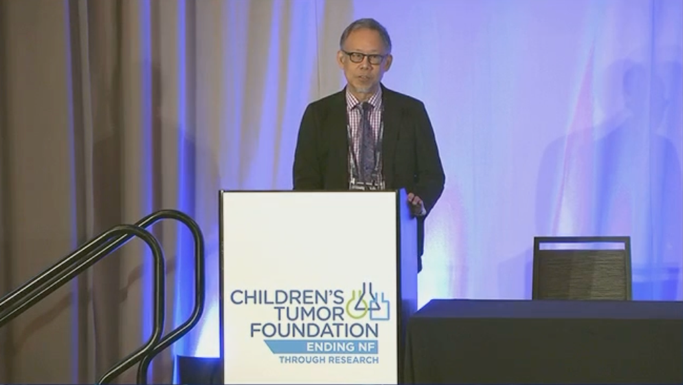
Speaker at the 2026 NF Conference: Dr Clement Cheung
New insights into pain – what does this mean for NF?
A special conference session was focussed on NF-related pain acknowledging its significant impact on a patient’s quality of life. To say the least, pain is complicated and one of the speakers in this session, Dr Deepak Ravindran from Teesside University in the UK, was invited to deconstruct this complexity as a start to better, more comprehensive pain care.
Dr Ravindran is a clinical physician, who primarily runs a general pain service. He is not a NF specialist but hopes sharing new insights into the complexity of pain can improve pain management in NF.
What do we know about pain in NF?
Many NF-patients struggle with chronic pain: 35-53% in NF1, 47% in NF-SWN and more than 50% in SWN. While almost 1 in 2 patients diagnosed with any form of NF suffers from chronic pain, the mechanisms of pain may not always be the same.
Is there more than one type of pain?
The 2 best known categories of pain are as follows:
1. Nociceptive pain
In general, this most common type of pain occurs when tissue anywhere in the body is damaged or injured, for example by a burn, cut or graze, muscle or ligament injury.
In NF specifically, nociceptive pain is often caused by skeletal compression, acute local inflammation or a tumour mass physically pressing on nerves at the pain site without directly damaging the nerve.
2. Neuropathic pain
This type of pain in NF is caused by a problem with nerves themselves or direct damage to a nerve, for example as an unwanted consequence of surgery. Neuropathic pain can also result in abnormal feelings like tingling or numbness or burning pain.
Is pain relief with medication effective in NF?
Pain medication can help NF patients with both nociceptive and neuropathic pain. Pain relief can be achieved with ‘over the counter’ pain medication like paracetamol, ibuprofen and non-steroidal anti-inflammatory drugs. Stronger medicines like opioids and gabapentinoids (specifically for nerve pain) require a prescription from your doctor.
However, experts in the field of pain management recognise that most standard pain medication given in pain clinics or clinical settings are not always as effective as we would hope. According to Dr Ravindran, the broad consensus is that ‘only 30% of patients experience about 30% of pain relief and they have about 30% of efficacy’. This suggests that only a fraction of NF patients with pain taking pain medication experience relief of pain. And when pain relief is felt, the level of relief seems less than expected.
How complex is pain in NF?
A recent scientific study on pain in NF showed that 20% of NF patients with chronic pain suffered from a type of pain that appeared different from nociceptive or neuropathic pain.
This led to the recognition of a new category of pain called nociplastic pain, which is included in the latest international pain management guidelines for clinicians.
How can this new type of pain be explained?
The mechanism of this new category of pain is different again:
3-Nociplastic pain
Chronic pain over time can sometimes change the way the body processes and feels pain. This means that pain can become much more severe or last much longer than expected from the initial injury. This pain is real even though it cannot be explained by the degree of tissue or nerve damage present.
Specifically in NF, a cause of nociplastic pain can be altered cell function as a result of the gene mutation underlying NF. This change at the cellular level can influence the local environment of the site where pain is perceived. Further complex changes throughout the nervous system involve neuroinflammation, altered pain signalling, and pain perception by a more sensitive brain to the pain signals.
How to deal with nociplastic pain?
It is important to know that pain relief with standard medication is ineffective to treat nociplastic pain. The underlying altered biology of this specific type of pain seems to make the brain more prone to pain perception. It even includes the lived experience and history of a patient’s pain record. Altogether, this can lower one’s threshold to pain.
Nociplastic pain makes pain even more complex and above all personal. It questions the focus on pain relief via medication only, and Dr Ravindran argued that particularly nociplastic pain can respond to lifestyle adjustments and mind-body therapies to train the brain.
What’s next?
Living with chronic pain could benefit from a comprehensive pain care approach in NF. Dr Ravindran generally supports the inclusion of pain medication and medical intervention where needed. But serious consideration of other contributing non-medical aspects of life of a patient with NF can be helpful as well. Examples would the patient’s environment, age and modifiable lifestyle variables, like diet, sleep, exercise and cognitive training.
According to Dr Ravindran, such an approach can reset brain sensitisation to the nociceptive signals that come from the pain site. As a result, this can change the conscious perception and emotions around pain for those living with the burden of chronic pain.
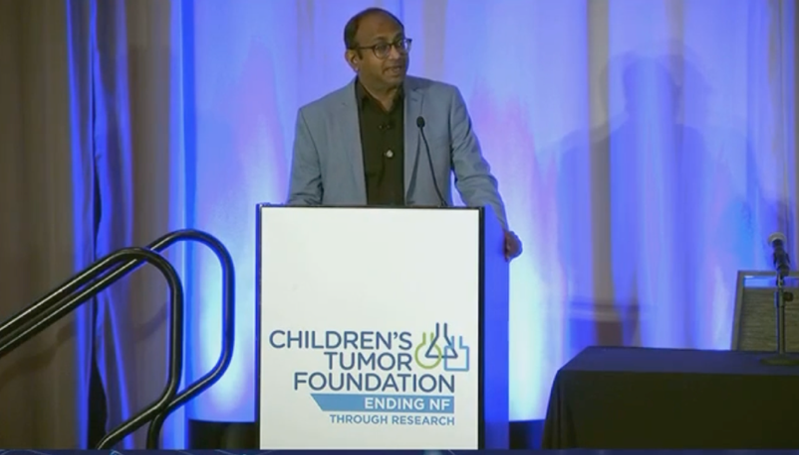
Speaker at the 2026 NF Conference: Dr Deepak Ravindran
This article was written by
Anke van Eekelen
Research volunteer

Share this article